
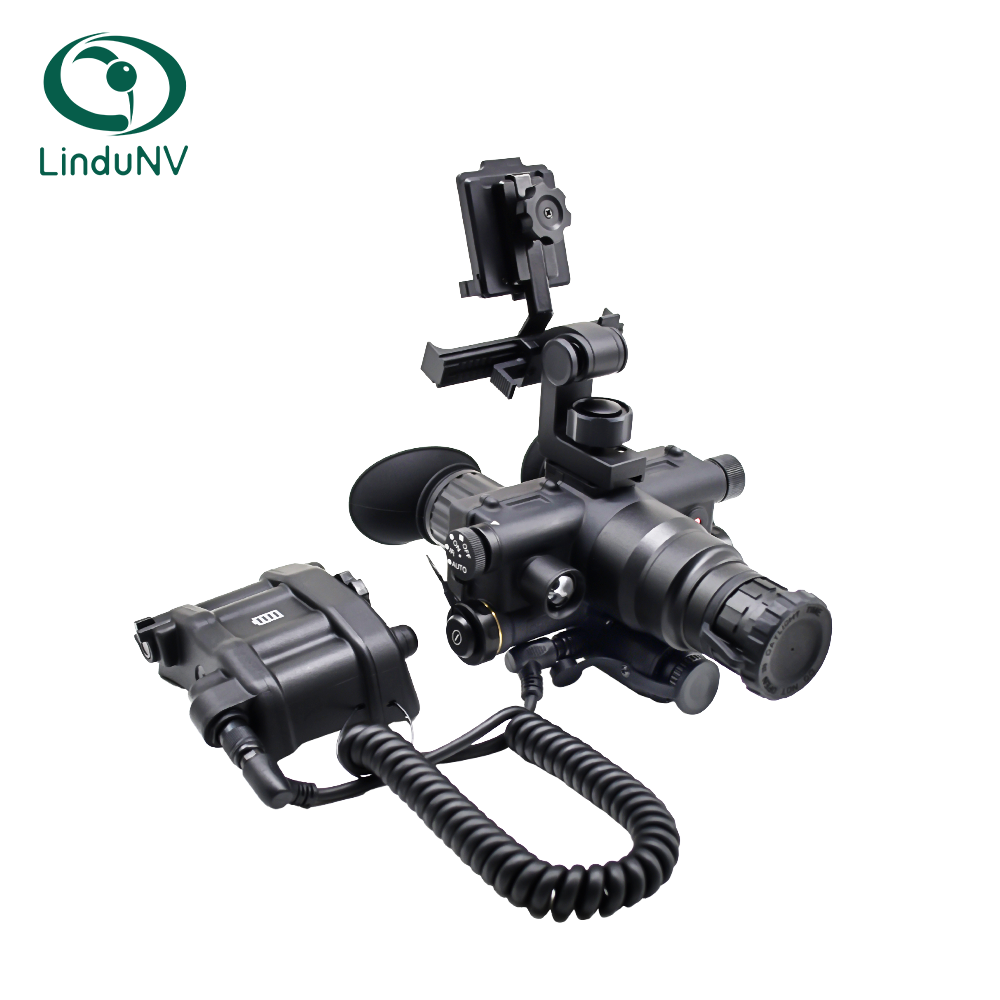
A conventional PVS-7 relies on image intensification to amplify available light.
The LDNV003TH adds a second sensing technology to that familiar head-mounted format: thermal imaging.
Instead of requiring a separate clip-on thermal module, the thermal detector is integrated directly into the night vision system.
The result is a PVS-7-style platform that can use image-intensified night vision and thermal imaging within one device, while allowing the two systems to operate separately when required.
What Is the LDNV003TH?
The LDNV003TH is a head-mounted night vision system that combines an image intensifier tube with an uncooled thermal imaging module.
The currently listed configuration uses a Gen2+ FOM1400+ image intensifier together with a 384×288 thermal detector.
These two sensors respond to different information in the scene.
The image intensifier amplifies available visible and near-infrared light, preserving much of the familiar structure and detail of a conventional night vision image.
The thermal detector responds to infrared radiation associated with temperature differences.
Combining both technologies gives the user access to two different ways of observing the same environment.
Why Combine Night Vision and Thermal Imaging?
Image intensification and thermal imaging do not solve exactly the same problem.
Traditional night vision is useful for seeing scene structure: roads, buildings, trees, terrain, equipment and other details illuminated by available ambient light.
Thermal imaging is useful for identifying temperature contrast that may not stand out clearly in an intensified image.
| Technology | Main Information |
| Image Intensification | Amplifies available scene light and preserves familiar visual detail |
| Thermal Imaging | Detects infrared radiation and highlights temperature differences |
This is why thermal fusion systems should not simply be described as “better night vision.”
They add a second sensing channel with different strengths.
The Night Vision Side: Gen2+ FOM1400+
The current LDNV003TH configuration is listed with a Gen2+ image intensifier rated at FOM1400+.
| Image Intensifier Specification | Listed Configuration |
| FOM | 1400+ |
| SNR | 23–25 dB |
| Resolution | 64–67 lp/mm |
| Gain | 20,000 cd/m²/lx |
| Phosphor | P43 green or P45 white depending on configuration |
The phosphor option should be confirmed before ordering because P43 and P45 configurations produce different image colors.
The Thermal Side: 384×288 Detector
The listed thermal module uses an uncooled 384×288 infrared detector operating in the 8–12 μm spectral range.
It uses a fixed-focus F1.0 objective, with the published focusing range extending from approximately 250 mm to infinity.
For this type of system, the thermal channel is not intended to replace the night vision image.
Its purpose is to provide additional thermal information that a conventional image intensifier cannot generate on its own.
The image intensifier helps you understand the scene. The thermal channel helps reveal heat contrast within that scene.
Five Thermal Display Modes
The LDNV003TH provides five selectable thermal image modes:
- White Hot
- Black Hot
- Green
- Red Hot
- Outline
These modes display the same thermal information in different ways.
White Hot and Black Hot provide conventional monochrome thermal views, while Red Hot and Outline modes can make specific areas of thermal contrast easier to notice visually.
Display brightness is also adjustable.
Night Vision and Thermal Can Operate Separately
One of the more useful aspects of the LDNV003TH architecture is that the night vision and thermal systems do not have to be used together at all times.
The two sensing systems can operate separately.
This matters because thermal imaging is not required for every situation.
When conventional image intensification already provides enough scene information, the user can rely on the night vision channel.
When thermal information becomes useful, the integrated thermal module is already available without attaching another device to the front of the goggle.
1× Magnification and a 40° Field of View
The night vision optical system uses 1× magnification and a 40°±2° field of view.
This is important because the LDNV003TH is designed as a head-mounted observation system rather than as a magnified thermal scope.
The optical specification also includes:
- F1.2 25 mm night vision optical system
- ±5° diopter adjustment
- 0.25 m to infinity focus range
- 2% maximum optical distortion
Keeping the night vision side at 1× makes the system more appropriate for natural head-mounted viewing where spatial awareness is more important than magnification.
Built-In IR and Automatic Power Control
The LDNV003TH includes an 850 nm, 20 mW infrared illuminator for situations where ambient light is insufficient for the image intensifier.
The control system provides ON, IR and AUTO switch modes together with an IR indicator and low-battery indicator.
Flip-up/down automatic power control is also included.
This allows the device to respond to its viewing position instead of requiring the user to manually operate the power control every time the goggle is raised or lowered.
Power: Internal and External Battery Options
The listed LDNV003TH configuration uses two CR123A batteries in the main unit.
It also supports an external battery pack using four CR123A batteries.
| Power Option | Battery |
| Main unit | 2 × CR123A |
| External battery pack | 4 × CR123A |
External power can be useful when building a complete head-mounted system and longer operating periods are expected.
Size, Weight and Environmental Protection
Integrating thermal imaging adds electronics and optical components that are not present in a standard PVS-7.
The current LDNV003TH specification lists:
- 115 × 127 × 69 mm dimensions
- 510 g weight excluding batteries
- −40°C to +55°C operating temperature range
- 5%–98% humidity range
- IP65 ingress protection as standard
- IP67 available as an optional configuration
For head-mounted use, that weight should be considered together with the helmet, mount and any external battery pack rather than evaluated in isolation.
LDNV003TH vs Standard PVS-7
The easiest way to understand the LDNV003TH is to compare it with a conventional LDNV003 PVS-7.
| Feature | LDNV003 PVS-7 | LDNV003TH |
| Image intensification | Yes | Yes |
| Integrated thermal | No | Yes |
| Thermal detector | — | 384×288 listed configuration |
| Magnification | 1× | 1× |
| NV field of view | 40°±2° | 40°±2° |
| Weight | 393 g without battery | 510 g without batteries |
| Primary difference | Conventional image-intensified night vision | Integrated night vision + thermal architecture |
If thermal capability is not required, the standard PVS-7 remains the simpler and lighter system.
The LDNV003TH makes more sense when the thermal channel is an important part of the intended setup.
You can also compare the conventional LDNV003 PVS-7 Night Vision Goggles in the LinduNV Store.
LDNV003TH vs PVS-7 + COTI
There is another way to add thermal capability to a PVS-7: attach a COTI.
The difference is mainly architectural.
| Approach | LDNV003TH | PVS-7 + COTI |
| Thermal design | Integrated into the goggle | External clip-on module |
| Modularity | Thermal remains part of the complete system | COTI can be removed and used with other compatible NVGs |
| Best fit | Buyer wants an integrated thermal/NV platform | Buyer already owns a compatible NVG or wants modular thermal |
The current LinduNV COTI is compatible with PVS-7, PVS-14, PVS-31 and GPNVG-18-style systems, so it is the more modular option.
The LDNV003TH takes the opposite approach: thermal capability is built into the system from the beginning.
For users who already own a night vision device, the LinduNV Clip-On Thermal Imager COTI may therefore be worth comparing before choosing an integrated fusion system.
Who Is the LDNV003TH Designed For?
The LDNV003TH is most relevant for buyers who specifically want both image intensification and thermal imaging in one head-mounted platform.
It is particularly worth considering when:
- Thermal information is an important part of the intended system.
- You prefer an integrated design rather than adding a separate COTI.
- You still want a 1× image-intensified viewing channel for normal night observation.
- You want thermal and night vision to remain separately usable.
- External battery support is useful for your helmet configuration.
If thermal imaging is only an occasional requirement, a conventional PVS-7 combined with a removable COTI may provide more flexibility.
Check the Configuration Before Ordering
The LDNV003TH is available in more than one possible configuration, so the model name alone does not tell you every specification.
Before ordering, confirm:
- Image intensifier generation and FOM
- P43 green or P45 white phosphor
- Thermal detector resolution
- IP65 or optional IP67 configuration
- External battery pack requirement
- Optional video output or Wi-Fi transmission accessories
The currently published base configuration is Gen2+ FOM1400+ with a 384×288 thermal detector. Other available options should be confirmed before purchase.
Integrated Thermal Changes What a PVS-7-Style System Can Do
The most important difference between the LDNV003TH and a conventional PVS-7 is not a higher magnification or a wider night vision field of view.
Both remain 1× head-mounted systems with a night vision field of view around 40°.
The real change is the addition of a second sensing technology.
The LDNV003TH keeps the scene detail of image-intensified night vision while adding access to thermal information within the same platform.
For buyers who want a dedicated fusion system rather than a modular clip-on solution, that integrated architecture is the main reason to choose it.
Explore LDNV003TH Thermal Fusion Night Vision
Compare LDNV003TH with conventional PVS-7 night vision and modular COTI thermal systems to choose the architecture that fits your setup.
View LinduNV StoreFrequently Asked Questions
What is the LDNV003TH?
The LDNV003TH is a PVS-7-style head-mounted system that combines image-intensified night vision with an integrated thermal imaging module.
What thermal resolution does the LDNV003TH use?
The currently listed configuration uses a 384×288 uncooled thermal detector. Availability and specifications of other thermal detector options should be confirmed before ordering.
Can the thermal and night vision systems work separately?
Yes. The LDNV003TH is designed so that its thermal imaging and image-intensified night vision functions can be operated separately.
What thermal image modes are available?
The current configuration provides White Hot, Black Hot, Green, Red Hot and Outline thermal display modes.
Is the LDNV003TH the same as a PVS-7 with COTI?
No. The LDNV003TH integrates the thermal module into the night vision system. A COTI is a removable thermal module that attaches to a compatible night vision device, making the COTI approach more modular.
Does the LDNV003TH use white or green phosphor?
The current specification lists both P43 green and P45 white phosphor depending on configuration. Confirm the phosphor option before ordering.
What batteries does the LDNV003TH use?
The listed main unit uses two CR123A batteries. An external battery pack using four CR123A batteries is also supported.
How much does the LDNV003TH weigh?
The currently published weight is approximately 510 g without batteries.