
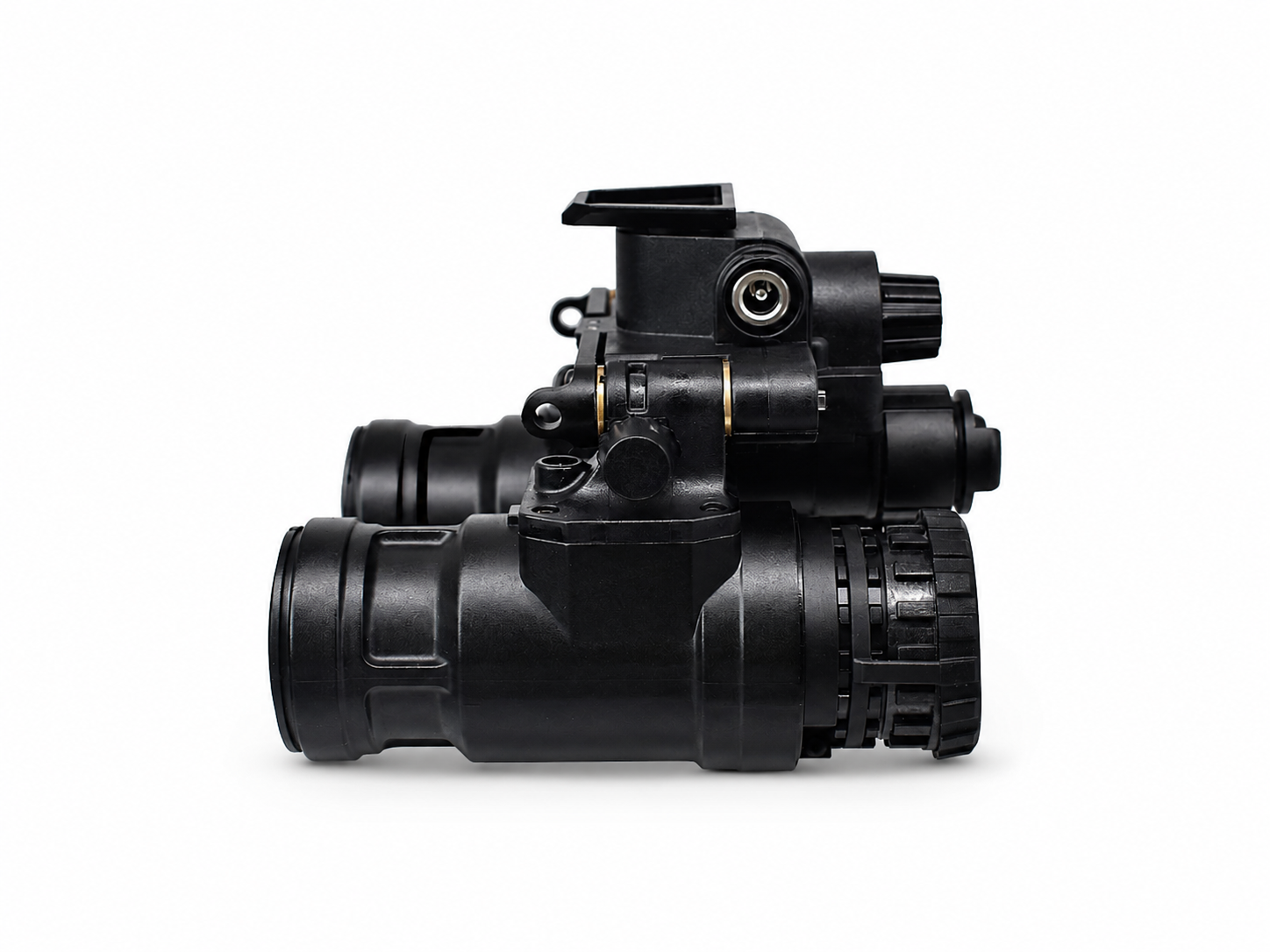
Buying a night vision device is only one part of building a head-mounted night vision system.
A PVS-14 monocular and a PVS-31-style binocular require different mounting components, and accessories that work with one configuration may not be necessary for the other.
A complete night vision helmet setup normally includes the NVG, the correct mounting interface, a helmet mount, a compatible helmet and, depending on the device, an optional external power system.
Understanding those parts before ordering can prevent compatibility problems and unnecessary accessories.
What Parts Make Up a Night Vision Helmet Setup?
The exact configuration depends on the night vision device, but most helmet-mounted systems are built around four basic areas:
- Night vision device — such as a PVS-14 monocular or PVS-31-style binocular.
- Device interface — a J-arm for many monocular setups or the integrated mounting interface on a binocular.
- Helmet mount — connects the night vision system to the helmet.
- Helmet — provides the platform that supports the complete assembly.
External battery packs, protective lenses and other accessories can then be added depending on the device and intended configuration.
PVS-14 Helmet Setup: Why You Need a J-Arm
A PVS-14 is a monocular, so it normally needs an additional arm between the night vision device and the helmet mount.
That component is commonly called a J-arm.
The basic mounting chain looks like this:
The current LinduNV Gen2+ PVS-14 weighs approximately 295 g without its battery and uses a 1× optical system with a 40°±2° field of view.
Its relatively low weight makes it suitable for a simple helmet-mounted setup without the additional mass of a binocular bridge or multiple image intensifier tubes.
LinduNV also offers a Metal Helmet Mount and J-arm for PVS-14 . The set uses aviation aluminum alloy and is designed specifically around the PVS-14 mounting format.
PVS-31 Helmet Setup: No Separate J-Arm Required
A PVS-31-style binocular is built differently.
The two optical pods are already connected by the binocular bridge, so a separate monocular J-arm is not normally part of the mounting chain.
The configuration is simpler:
The current LDNVG31 weighs approximately 480 g including its image intensifier tubes and supports internal CR123 or AA battery operation as well as an external battery pack.
Because the binocular is heavier than a PVS-14, mount adjustment and helmet fit become increasingly important.
The current Helmet Mount for PVS-31 is made from aviation aluminum alloy and provides vertical, horizontal and radial adjustment. The same product is also listed as compatible with GPNVG-18 and BNVD-style systems.
PVS-14 vs PVS-31 Helmet Setup
| Setup Area | PVS-14 | PVS-31 |
| Device type | Monocular | Binocular |
| J-arm required | Normally yes | No separate J-arm |
| Current LinduNV device weight | 295 g without battery | 480 g including tubes |
| Internal power | CR123A | CR123 / AA |
| External battery support | Depends on model/configuration | Supported |
| Setup complexity | Simple, but requires J-arm | Integrated binocular mounting interface |
Choosing the Correct Helmet Mount
The helmet mount is not just a connector.
It determines how the night vision device is positioned in front of the eyes and how easily the user can move the system into or out of the viewing position.
Useful adjustments can include:
- Vertical position
- Forward and backward position
- Horizontal alignment
- Viewing angle
- Flip-up or stowed position
The goal is not simply to attach the NVG securely. The eyepiece also needs to sit in a position that allows comfortable viewing without forcing the user to constantly adjust head position.
The LinduNV Night Vision Helmet Mount uses a multi-axis adjustable design and is intended to work with compatible monocular and binocular interfaces.
Why Helmet Fit Matters
A good mount cannot compensate for a helmet that moves excessively on the user's head.
Once a night vision device is installed, its weight sits forward of the face. If the helmet is loose, the entire optical position can shift when the user walks, turns or looks downward.
This becomes increasingly noticeable as device weight rises.
A 295 g PVS-14 places less mass at the front than a 480 g binocular, while panoramic systems such as GPNVG-18 add even more.
Helmet padding and adjustment should therefore be treated as part of the optical setup rather than as an unrelated accessory.
Do You Need an External Battery Pack?
Not every night vision helmet setup needs one.
A PVS-14 can operate directly from its internal battery, so an external power system is unnecessary for a basic configuration.
The LDNVG31 also supports internal power, which means an external battery pack remains optional rather than mandatory.
External power becomes useful when the user wants additional battery capacity or prefers to move the battery away from the goggle itself.
The LinduNV Store currently offers a PVS-31 Compatible 4-Pin Remote Battery Pack alongside other night vision power accessories.
Always confirm the power connector and voltage requirements before connecting an external pack to a night vision device.
An External Battery Pack Is Not Automatically a Counterweight
External battery packs are often positioned toward the rear of a helmet, so they can influence the overall balance of the system.
However, their primary purpose is still power.
The correct balance depends on the weight of the NVG, mount, helmet, battery pack and any other equipment installed on the helmet.
A heavier rear battery is not automatically better. The goal should be a stable helmet that does not pull excessively forward or backward.
Check Compatibility Before Ordering
One of the easiest mistakes is assuming that every part labeled “night vision mount” works with every night vision device.
Before ordering a complete setup, confirm these interfaces:
| Check | Why It Matters |
| NVG to J-arm | Relevant mainly to monocular systems such as PVS-14 |
| J-arm or binocular to mount | The mounting interface must physically match |
| Mount to helmet | The helmet needs a compatible mounting point or shroud |
| Battery pack connector | Connector type and electrical requirements must match the NVG |
Checking these four points before purchase is easier than trying to solve an interface mismatch after every component arrives.
A Simple PVS-14 Shopping List
For a basic helmet-mounted PVS-14 system, start with:
- PVS-14 night vision monocular
- Compatible J-arm
- Helmet mount
- Compatible night vision helmet
The PVS-14 already contains its own battery system, so this setup can remain relatively simple.
A Simple PVS-31 Shopping List
For a basic PVS-31-style binocular system, start with:
- PVS-31-style night vision binocular
- Compatible binocular helmet mount
- Night vision helmet
- Optional external battery pack
A separate J-arm is normally unnecessary because the binocular already includes its bridge and mounting architecture.
Which Setup Is Simpler?
A PVS-14 uses more individual mounting pieces because the monocular needs a J-arm, but the complete system remains lighter.
A PVS-31 removes the separate J-arm and provides binocular viewing, but its greater front-mounted weight makes helmet adjustment and balance more important.
Neither arrangement is automatically better.
Choose the NVG first, then build the helmet setup around that device rather than buying mounts and accessories before deciding which night vision platform you will use.
Build Your Night Vision Setup
Browse current LinduNV helmet mounts, PVS-14 J-arms, night vision helmets, battery packs and other compatible accessories.
Shop Night Vision AccessoriesFrequently Asked Questions
Do I need a J-arm for a PVS-14?
For a conventional helmet-mounted PVS-14 setup, a compatible J-arm normally connects the monocular to the helmet mount.
Does a PVS-31 need a J-arm?
No separate monocular J-arm is normally required. A PVS-31-style binocular has its own bridge and mounting interface and connects to a compatible binocular helmet mount.
Do I need an external battery pack for PVS-31?
No. The current LDNVG31 supports internal battery operation. An external battery pack is optional for users who want a different power configuration or additional battery capacity.
Can the same helmet mount work with PVS-31 and GPNVG-18?
The current LinduNV Helmet Mount for PVS-31 is listed as compatible with PVS-31, GPNVG-18 and BNVD-style night vision devices. Always confirm the exact mounting interface of the specific device before ordering.
Is a heavier night vision device harder to helmet mount?
The mounting process is not necessarily harder, but additional front weight makes helmet fit, mount adjustment and overall balance more important.
Should I buy the helmet or NVG first?
Choose the night vision platform first. Once you know whether you are using a PVS-14, PVS-31 or another system, it becomes much easier to select the correct J-arm, mount, helmet and power accessories.