
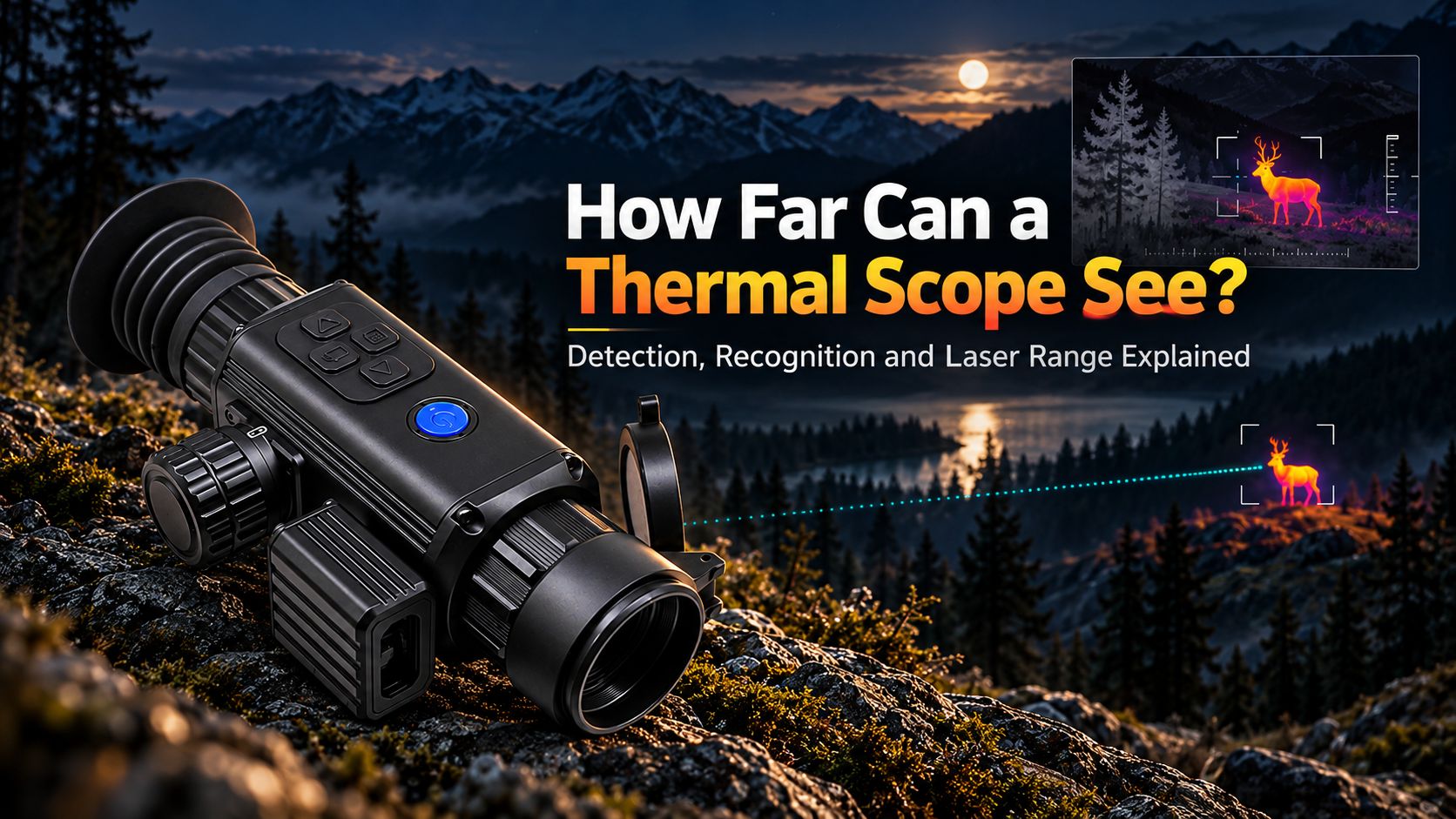
One of the most common questions about thermal imaging is simple: How far can a thermal scope actually see?
The answer is more complicated than a single distance.
A thermal device may detect a heat source at a long distance while providing too little detail to tell exactly what the object is. If the same device also includes a laser rangefinder, its maximum ranging distance may be completely different again.
Thermal detection range, recognition range and laser ranging distance describe three different things.
Understanding those differences makes it much easier to compare thermal monoculars, thermal scopes and clip-on thermal imagers.
What Does Thermal Detection Range Mean?
Detection range is the distance at which the thermal imaging system can provide enough information to show that a target or heat source is present.
At this distance, the object may appear only as a small thermal shape.
You may know that something warm is standing near the edge of a field, for example, without having enough image detail to determine exactly what it is.
This is why the longest range number on a thermal product page is often a detection figure rather than a recognition or identification figure.
Detection and Recognition Are Not the Same
Recognition requires more information than detection.
A target has to occupy enough detector pixels for its general shape and thermal pattern to become useful.
| Range Type | What You Can Determine |
| Detection | A thermal target is present |
| Recognition | The general type of object can be distinguished |
| Identification | Finer target characteristics can be resolved for the required observation task |
In normal conditions, detection distance is therefore longer than recognition distance, while identification generally requires the target to be closer again.
Why Thermal Resolution Changes Viewing Distance
The thermal detector contains a fixed number of sensing pixels.
Common detector resolutions include:
- 256 × 192
- 320 × 240
- 384 × 288
- 640 × 512
As a target moves farther away, it occupies fewer of those pixels.
A higher-resolution detector gives the imaging system more available samples. When optics and field of view are comparable, that can help retain useful target detail at longer distances.
However, detector resolution alone is not enough to predict range.
Lens Focal Length Matters Too
The thermal lens determines how the scene is projected onto the detector.
A shorter focal length normally provides a wider field of view, making it easier to scan a larger area.
A longer focal length normally concentrates the detector on a smaller angular area. Under comparable detector conditions, this places more pixels across a distant target.
This is why two devices using different lens focal lengths can have very different long-range performance even if their detector resolutions look similar.
LDTI008: A Clear Example of Different Detection Ranges
The LinduNV LDTI008 series shows how detector resolution and lens focal length work together.
| Model | Detector | Lens | Human Detection | Car Detection |
| LDTI008-225LRF | 256 × 192 | 25 mm | 600 m | 1,100 m |
| LDTI008-335LRF | 384 × 288 | 35 mm | 1,000 m | 1,900 m |
| LDTI008-650LRF | 640 × 512 | 50 mm | 1,700 m | 3,000 m |
The three versions also use the same 12 μm pixel pitch and 50 Hz refresh rate.
The longer-range versions combine a larger detector with a longer focal-length objective, so the increase in detection distance is the result of the complete optical and detector configuration rather than one specification by itself.
Why Cars Can Be Detected Farther Away Than People
Target size changes thermal detection range.
A vehicle is physically larger than a person, so it normally occupies more detector pixels at the same distance.
That is why the LDTI008 specifications list a longer detection distance for cars than for people across all three versions.
This also means that a thermal range figure is incomplete if the target size is not stated.
Laser Rangefinder Distance Is a Different Specification
Thermal devices with an integrated laser rangefinder often show another large distance figure.
That number describes the ranging system, not the thermal detector.
A laser rangefinder may successfully measure the distance to an object even when the thermal image does not contain enough detail to recognize or identify that object.
For example, the LDTI006 uses pulse Time-of-Flight ranging and is specified for at least 1,200 m on buildings and at least 800 m in forest environments.
Those distances describe the laser rangefinder.
They should not be interpreted as 1,200 m human recognition or identification distances for the 320 × 240 thermal detector.
LDTI006: Wide-Field Thermal Observation with Integrated Ranging
The LDTI006 takes a different approach from a long-focal-length thermal scope.
Its thermal system uses:
- 320 × 240 thermal resolution
- 12 μm pixel pitch
- 9.7 mm objective lens
- 18.1° × 13.6° field of view
- <40 mK NETD
- 50 Hz refresh rate
The relatively short 9.7 mm lens provides a wider field of view than a long-focal-length thermal optic, making the device well suited to scanning larger areas and maintaining more surrounding context in the image.
Its integrated laser rangefinder then provides a separate distance measurement once an object has been located.
COTI Shows Why Detection and Recognition Should Be Listed Separately
The LinduNV COTI provides another useful example.
For a 1.7 m human target, its current specifications list:
| Observation Task | Published Range |
| Detection | 450 m |
| Recognition | 350 m |
Nothing physically changes inside the device between 450 m and 350 m.
The difference is the amount of information required from the image.
At the longer distance, the system may show that a thermal target exists. At the closer distance, the image provides enough information for general recognition.
NETD Can Affect What You See in Low-Contrast Conditions
Distance is not only about target size and resolution.
The target also needs to produce enough thermal contrast against its surroundings.
A person against a cold background may be easier to detect than the same person in an environment where the ground, vegetation and surrounding objects have reached similar temperatures.
NETD describes the thermal sensitivity of the detector. A lower NETD means the system can distinguish smaller temperature differences under the specified test conditions.
This can improve image usability in difficult low-contrast scenes, although NETD alone does not determine a fixed detection distance.
Weather Can Reduce Long-Range Thermal Performance
Thermal radiation has to travel through the atmosphere before reaching the detector.
High humidity, fog, rain and other atmospheric conditions can reduce infrared transmission and target contrast.
These effects become increasingly relevant at longer distances.
For this reason, a published detection range should be treated as a performance reference rather than a guaranteed viewing distance under every weather condition.
Does Digital Zoom Increase Thermal Range?
Digital zoom can make a target appear larger on the display.
It does not add new thermal information.
If a target occupies only a few native detector pixels, 4× or 8× digital zoom enlarges those pixels rather than adding additional detail from the scene.
This is different from using a longer focal-length objective, which changes how the target is projected onto the detector before the image is captured.
How to Compare Thermal Range Before Buying
Before comparing two thermal devices, check more than the largest distance printed on the product page.
- Check what the distance means. Detection, recognition and laser ranging are different.
- Check the target type. Human and vehicle ranges should not be compared directly.
- Check detector resolution. More native pixels can preserve more target detail.
- Check lens focal length and field of view. Wide scanning and long-distance detail require different optical choices.
- Check pixel pitch and NETD. They affect angular sampling and thermal sensitivity.
- Consider the environment. Weather and thermal contrast influence real-world performance.
A complete specification sheet is much more useful than one large range number.
Which LinduNV Thermal Configuration Fits Different Observation Needs?
The current LinduNV thermal range includes several different system approaches.
| Product | Key Configuration | Useful For |
| LDTI006 | 320 × 240, 9.7 mm, wide 18.1° FOV, integrated LRF | Wide-area thermal scanning with separate distance measurement |
| LDTI008 Series | 256 × 192 to 640 × 512, 25–50 mm lenses | Different long-range observation requirements |
| COTI | 384 × 288 thermal module with clip-on operation | Adding thermal awareness to compatible night vision systems |
Explore LinduNV Thermal Imaging
Compare thermal detector resolution, lens focal length, field of view, laser ranging and other specifications across the current LinduNV thermal imaging range.
Browse Thermal ImagingFrequently Asked Questions
How far can a thermal scope detect a person?
It depends on detector resolution, lens focal length, pixel pitch, thermal contrast and weather. Current LDTI008 configurations publish human detection distances from 600 m to 1,700 m depending on the model.
Is thermal detection range the same as recognition range?
No. Detection means showing that a thermal target is present. Recognition requires more image detail and is therefore normally achieved at a shorter distance.
Why can a thermal scope detect a car farther away than a person?
A vehicle is larger and normally occupies more detector pixels at the same distance, making it easier to detect at longer range.
Does a laser rangefinder increase thermal detection range?
No. The laser rangefinder measures distance through a separate ranging system. It does not increase the number of thermal pixels or change the detector's imaging performance.
Does 8× digital zoom let a thermal scope see eight times farther?
No. Digital zoom enlarges existing detector data. It does not create additional native thermal detail or multiply the true detection distance by eight.
What affects thermal detection range the most?
Detector resolution, lens focal length, pixel pitch, target size, thermal contrast, NETD, atmospheric conditions and image processing all contribute to the usable range of a thermal imaging system.